
What is the maximal age a Bank vole reaches?
An adult Bank vole (Myodes glareolus) usually gets as old as 4.83 years.
Bank voles are around 19 days in the womb of their mother. When born, they weight 1 grams (0 lbs) and measure 3 cm (0′ 2″). As a member of the Cricetidae family (genus: Myodes), a Bank vole caries out around 4 little ones per pregnancy, which happens around 3 times a year. Fully grown, they reach a bodylength of 10.6 cm (0′ 5″).
As a reference: Usually, humans get as old as 100 years, with the average being around 75 years. After being carried in the belly of their mother for 280 days (40 weeks), they grow to an average size of 1.65m (5′ 5″) and weight in at 62 kg (137 lbs), which is obviously highly individual.
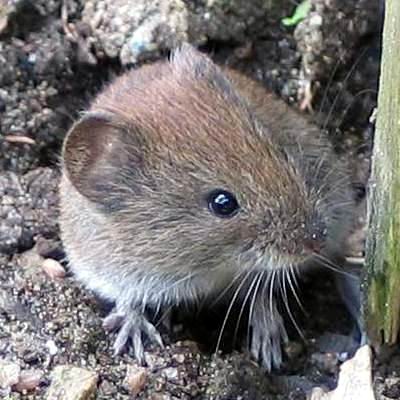
The bank vole (Myodes glareolus; formerly Clethrionomys glareolus) is a small vole with red-brown fur and some grey patches, with a tail about half as long as its body. A rodent, it lives in woodland areas and is around 100 millimetres (3.9 in) in length. The bank vole is found in much of Europe and in northwestern Asia. It is native to Great Britain but not to Ireland, where it has been accidentally introduced, and has now colonised much of the south and southwest.The bank vole lives in woodland, hedgerows and other dense vegetation such as bracken and bramble. Its underground chamber is lined with moss, feathers and vegetable fibre and contains a store of food. It can live for eighteen months to two years in the wild and over 42 months in captivity and is mostly herbivorous, eating buds, bark, seeds, nuts, leaves and fruits and occasionally insects and other small invertebrates. It readily climbs into scrub and low branches of trees although it is not as versatile as a mouse. It breeds in shallow burrows, the female rearing about four litters of pups during the summer.
Animals of the same family as a Bank vole
Not really brothers and sisters, but from the same biological family (Cricetidae):
- Altiplano grass mouse bringing the scale to 20 grams
- Gerbil leaf-eared mouse bringing the scale to 17 grams
- Córdoba vesper mouse bringing the scale to 49 grams
- Kolan vole with 1 babies per pregnancy
- Tien Shan red-backed vole with 4 babies per pregnancy
- Hylaeamys laticeps bringing the scale to 49 grams
- Northern red-backed vole with 5 babies per pregnancy
- Grey red-backed vole with 5 babies per pregnancy
- Olive grass mouse becoming 1 years old
- Blackish grass mouse bringing the scale to 19 grams
Animals that reach the same age as Bank vole
With an average age of 4.83 years, Bank vole are in good companionship of the following animals:
- Meadow jumping mouse usually reaching 5 years
- Plains rat usually reaching 5.58 years
- Tullberg’s soft-furred mouse usually reaching 5.17 years
- Southern long-nosed bat usually reaching 5 years
- Northern grasshopper mouse usually reaching 5 years
- African striped weasel usually reaching 5.17 years
- Silky pocket mouse usually reaching 5 years
- Brown-tailed mongoose usually reaching 4.75 years
- Val’s gundi usually reaching 5 years
- Little free-tailed bat usually reaching 5 years
Animals with the same number of babies Bank vole
The same number of babies at once (4) are born by:
- Ethiopian white-footed mouse
- Ornate shrew
- Nectomys squamipes
- Western harvest mouse
- African pygmy mouse
- New Holland mouse
- Dice’s cottontail
- Large Japanese field mouse
- American red squirrel
- Akodon boliviensis
Weighting as much as Bank vole
A fully grown Bank vole reaches around 20 grams (0.04 lbs). So do these animals:
- Kilimanjaro shrew with 16 grams
- Ural field mouse with 18 grams
- Smoky grass mouse with 22 grams
- Ghost-faced bat with 16 grams
- Davis’s round-eared bat with 20 grams
- Schultz’s round-eared bat with 18 grams
- Lesser false vampire bat with 24 grams
- Lesser mouse-eared bat with 23 grams
- Veldkamp’s dwarf epauletted fruit bat with 21 grams
- Woodland jumping mouse with 22 grams
Animals as big as a Bank vole
Those animals grow as big as a Bank vole:
- Arends’s golden mole with 12.3 cm (0′ 5″)
- Highland brush mouse with 12.7 cm (0′ 5″)
- Neotropical pygmy squirrel with 11.1 cm (0′ 5″)
- Forest dormouse with 10.5 cm (0′ 5″)
- Gray-bellied tree mouse with 10.8 cm (0′ 5″)
- Stephens’s kangaroo rat with 11.6 cm (0′ 5″)
- Long-tailed pocket mouse with 9.7 cm (0′ 4″)
- Chisel-toothed kangaroo rat with 11.2 cm (0′ 5″)
- Red-cheeked dunnart with 11 cm (0′ 5″)
- São Paulo grass mouse with 8.8 cm (0′ 4″)